
When Spanish pottery was the currency for barter
Author Annie Dillard once wrote that “how we spend our days is how we spend our lives.” Perhaps no art form celebrates the minutiae of everyday life better than genre paintings.
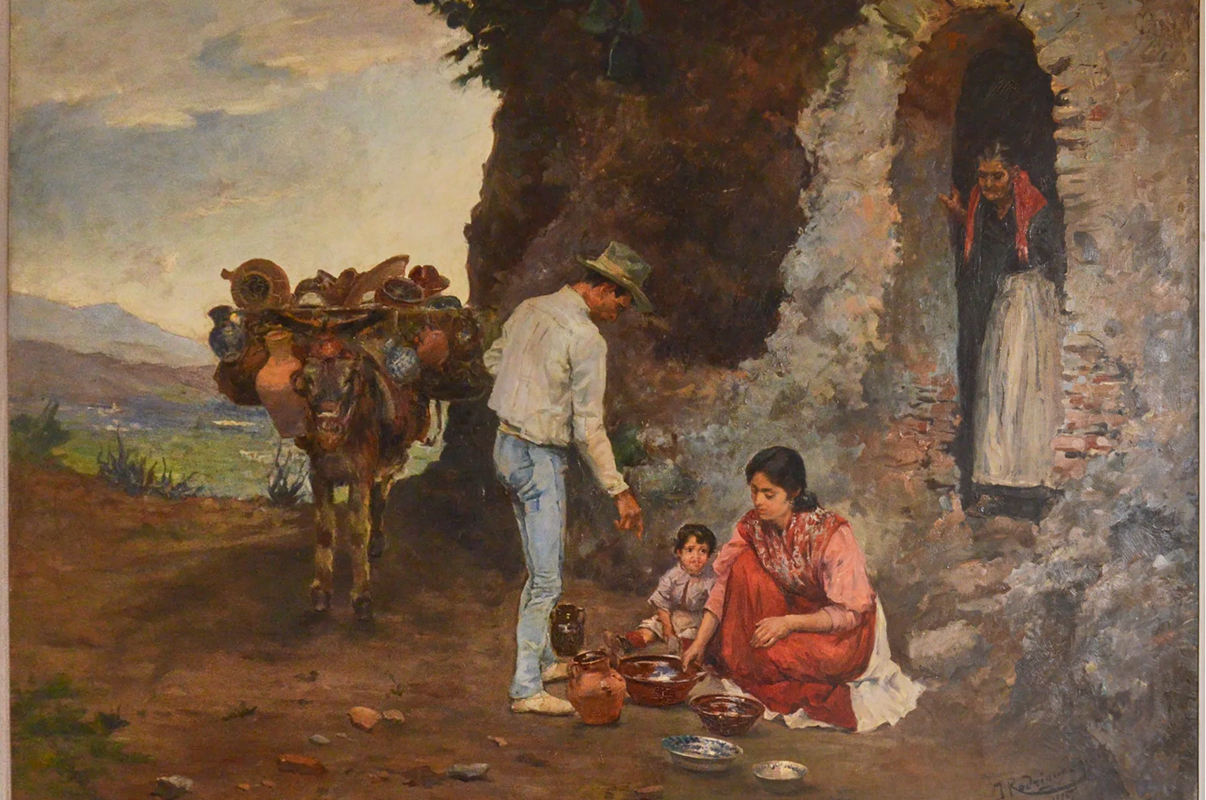
El Cacherrero, 1895 painting by José María Rodríguez-Acosta
Most closely associated with the Flemish school that gave the world such talents as Vermeer, de Hooch and Steen, genre paintings show that the complexities and joys of everyday life are not at all trivial.
While a grand classical oeuvre like a Botticelli inspires treaties on beauty, a genre painting tells us what people at a particular time actually found beautiful.
A Vermeer tells us how 17th century Dutch householders lived, or at least how they aspired to live, since paintings— like magazine photographs— are carefully crafted sets.
In Spain, genre painting became exceedingly popular in the late 19th century, just in time to memorialize a way of life that was quickly eclipsed by the Industrial Revolution.
In El Cacharrero, José María Rodríguez-Acosta offers myriad insights into Andalusian life at the turn of the 20th century. Painted in 1895, the scene depicts a muleteer and his beast of burden, loaded with “cacharros” — all manner of ceramics.


Handmade in Granada, home of Fajalauza ceramics, El Carmen Spanish Traditional Lebrillo features a striking design that recalls the lush courtyard or "carmen" Andalusian homes.
A large sunflower bouquet covers the base of the basin while the walls bear a design of undulating motifs. The artist has lingered over the details in the bird’s plumage and the seeds of the flowers.
This large flat-bottomed vessel was once used as a washing basin for laundry, a necessity in any home. The lebrillo has since transcended its utilitarian role.
Its distinctive designs and lively colors make for stunning décor in the home or garden. Inspired by the Andalusian landscape, lebrillo often feature the granada or pomegranate, sunflowers, daisies, palms, peacocks and native songbirds.
Lebrillo Wall Mounts for hanging available here.
Production Lead Time: Kindly note, while we do hold some stock, many of our items are made to order. If out of stock, the production lead time is 4-6 weeks. For updates on current availability, please contact hello@casapletorica.com.
In the foreground of the painting, a woman huddles on the ground to inspect a few lebrillos — some painted, others in glazed terracotta finish.
Though now beloved for its unique motifs, the lebrillo once served a functional role in every household. As depicted in various 19th century paintings, extra-large lebrillos were especially useful for laundry while smaller bowls worked well for kitchen chores.
A 19th century delivery service
At a time when modern life means constantly sidesteppping frenzied delivery bikes and vans criss-crossing the city to deliver as they rush to deliver millions of packages a day, the muleteer seems amusingly quaint.
Yet, once upon a time, he was actually indispensable to many trades including pottery.
Before motorized cars, the muleteer or arriero transported clay from the quarry to the potter’s workshop and he delivered hay for packaging. The wood for the traditional kiln would also arrive by mule.
Once out of the oven, the muleteer transported the best finished pieces, wrapped in rye, to the shops for sale or to the train station.

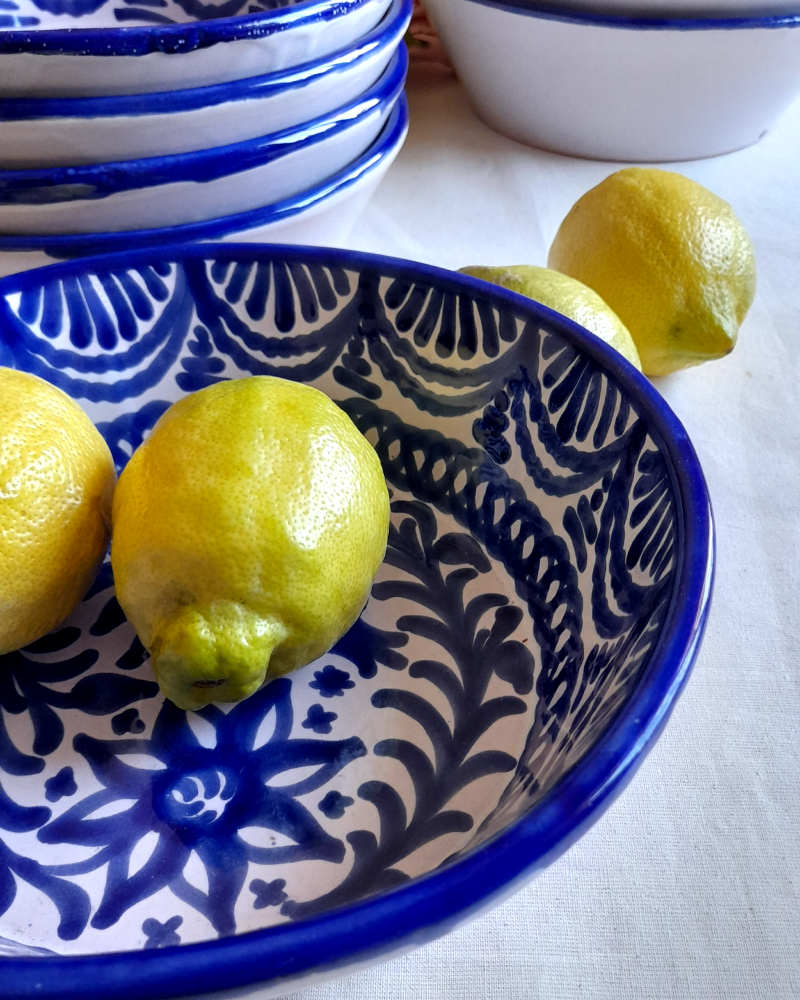

This beautiful handmade bowl features the traditional Fajalauza motifs of pomegranate fruit and flowers as well as ornamental details along the body. A panoply of decorative elements resembling sea shells the bowl from bottom to rim.
Hand-painted in indigo blue in southern Spain by our artisan partners, the lebrillo is a traditional Spanish bowl with a flat bottom and a trapezoidal shape.
Dating back to Spain's Moorish era, these pieces are used for eating or decorating.
Production Lead Time: Kindly note, while we do hold some stock, many of our items are made to order. If out of stock, the production lead time is 4-6 weeks. For updates on current availability, please contact hello@casapletorica.com.
Before the introduction of plastics, earthenware pots and bowls were indispensable to every household. In fact, they were sometimes used as currency for barter.
A pot worth its weight in Moscatel
As late as the 1950s, door-to-door salespeople along the small towns in the Ajarquía region would exchange ceramic bowls for the region’s rich in Moscatel grape, now famous for its wine.
Each bowl was worth the amount of fruit that would fit in it.
In El Cacharrero, our muleteer salesman offers an eclectic set of items. We spy several Fajalauza-style pieces: a small bowl, a larger lebrillo bowl and two pitchers featuring all-over decoration.
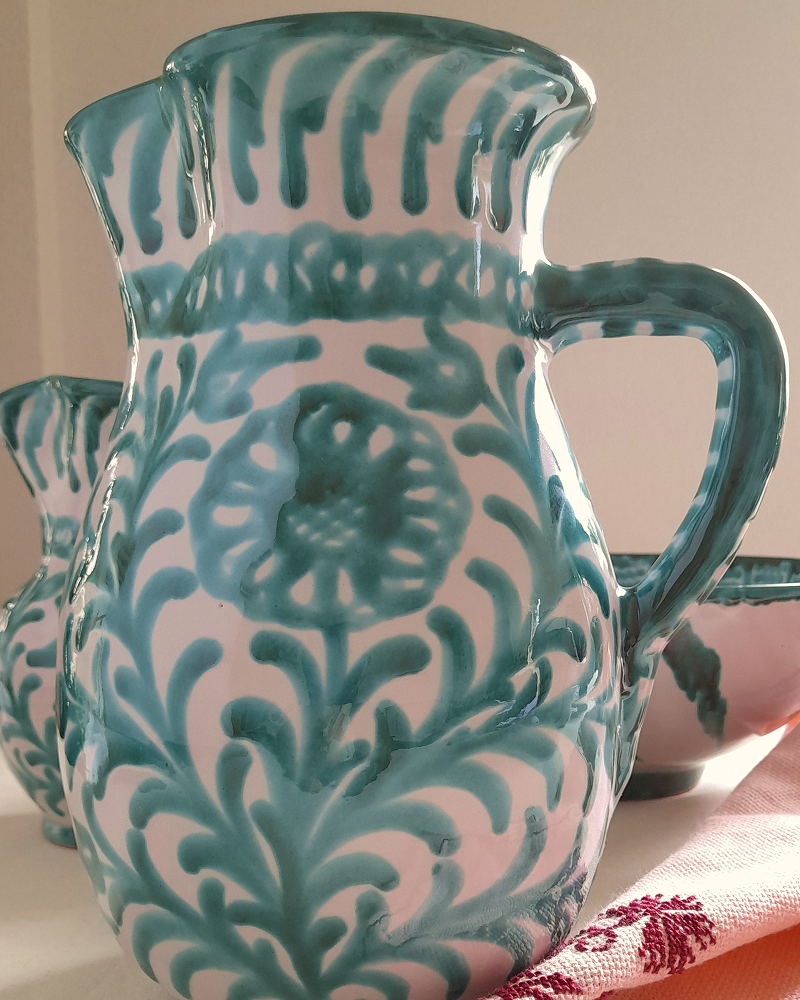
The Large Margarita Fajalauza Large Pitcher in Green boasts the intricate all-over decoration that has become synonymous with this Andalusian pottery.
Hand painted in a vibrant copper green over white glaze, the composition has three scenes. Cheerful daisies set amid wreaths of smaller buds sit on either side of the handle. The large pomegranate (granada) on the flank is a nod to the hometown of this centenarian ceramic tradition. A slender bird, perhaps a curlew with mottled plumage, stretches up toward the ripened fruit.
The design covers the entire surface of the vase from base to spout.
This large pitcher makes is a perfect match for our Girasol Fajalauza Small Pitcher in Green.
Dimensions: 24 cm | 9.5 in, 12 cm | 4.8 in
Capacity: 2L or 67.6 oz
Production Lead Time: Kindly note, while we do hold some stock, many of our items are made to order. If out of stock, the production lead time is 4-6 weeks. For updates on current availability, please contact hello@casapletorica.com.
Though detractors of genre paintings sometimes dismiss such scenes in favor of classical subjects and fine portraiture, these works are like illustrated history books from bygone eras. They corroborate what historians and diarists wrote, bringing the past back to us in vivid color.
For more designs, custom size or color, please get in touch.
