A Menorca home blends Spanish craft and modern art
One of the most delightful characteristics of an old property is the story of those who lived within its walls.
In the 18th century a small family-run shoe company worked and lived in this building. This arrangement remains fairly common among storeowners in small towns across Spain and its islands, with the shop on the ground floor and living quarters above. By the mid-19th century, a silver and jewelry workshop had set up on the premises.
Today this gently renovated home in Menorca’s capital of Mahón is the perfect bolthole for a couple of young art lovers.
While visitors flock to Menorca to enjoy its unspoilt landscape and beaches, a large expat community has found a permanent home here. In recent years, its thriving art scene has made it even more attractive to young aesthetes.
“We have not laid a single tile here,” the new owners told AD in an interview. “For us the floors and ceilings are the main protagonists.”
Done in terracotta tiles that keep the home cooler in the hot Mediterranean summer, the floors add a wonderful rustic quality that balances the bevy of contemporary art displayed in the home.
Striking a careful balance between old and new, this kitchen is filled with objects that honor traditional crafts. Antique terracotta pots sit on the counter. A few Spanish lebrillo bowls perch above.
The exposed beams and white-washed walls established a raw, understated atmosphere while pastel green cabinet curtains soften the look.
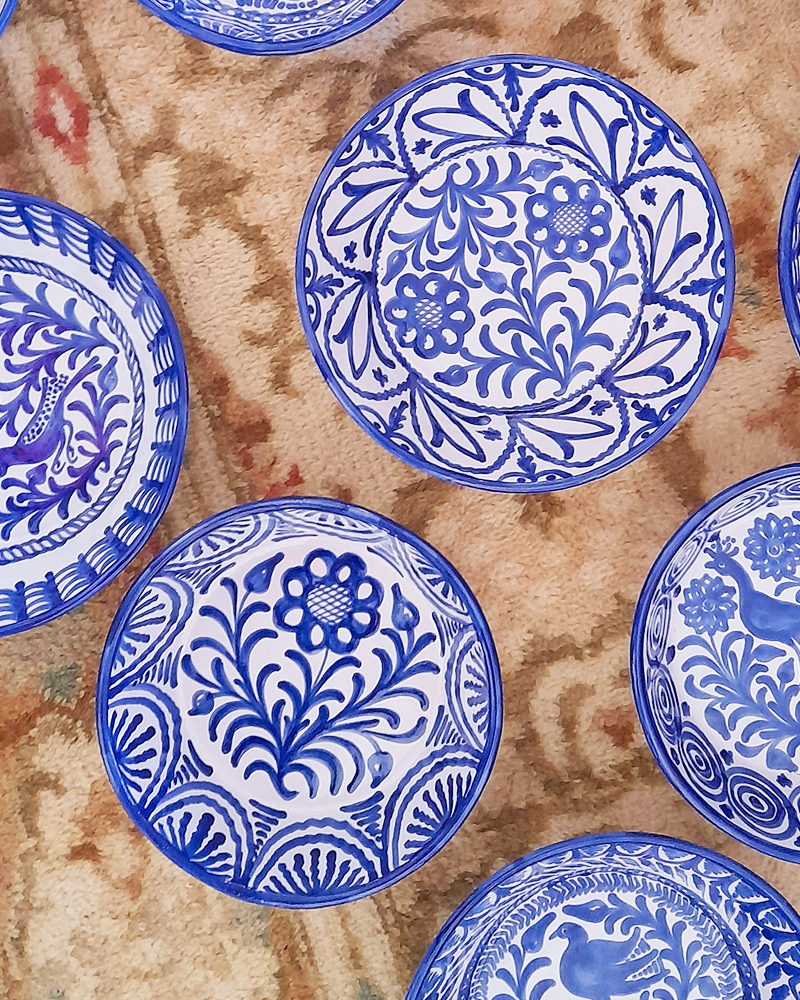


Gavilla de Flores Small Serving Bowl features a floral in the center of this flat-bottomed bowl. The walls of the bowl boast a motif that ressembles sea shells.
Hand-painted in indigo blue by our artisan partners in southern Spain, this bowl adds an effortless elegance to any table setting.
Similar in shape to the traditional lebrillo, the serving bowl or "fuente semillana" is a large flat-bottomed vessel commonly found in Spanish homes. Filled with fruits and nuts, the fuente makes for a perfect centerpiece.
This piece, much like our beloved lebrillo, is often used as a decorate accent on walls and shelves.
Production Lead Time: Kindly note, while we do hold some stock, many of our items are made to order. If out of stock, the production lead time is 4-6 weeks. For updates on current availability, please contact hello@casapletorica.com.
Given the muted tones —whitewashed walls, unpainted wooden furnishings, terracotta floors— the stained glass of the transom and in the double doors leading to the dining area are a welcome surprise.
A hand-painted ceramic pitcher typically of southern Spain sits on the table. Popular in the 19th century, these unusually shaped vases have a understated charm.
Their unique silhouette makes them unmistakable: an ovoid body, a long wide neck that forms a short spout on one side and a slender handle on the other.
Though made in more colorful styles, this vase often comes in its most elemental form: lightly decorated with blue hands around the body and top of the neck.

Our Fajalauza Girasol Pitcher in Green features plump girasoles or sunflowers along its round belly. Painted in our traditional copper green, the pitcher may also serve as a vase.
Decorated with pomegranates, smaller flowers and overlapping branches in green over white glaze.
Hand-crafted in southern Spain.
Dimensions: 16 cm x 11cm | 6.3 in x 4.3 in
Capacity: 0.65L | 22 oz
Production Lead Time: Kindly note, while we do hold some stock, many of our items are made to order. If out of stock, the production lead time is 4-6 weeks. For updates on current availability, please contact hello@casapletorica.com.
Of course, a Menorca apartment would not do itself justice if it did not have a terrace from which to watch the sunset. Here, the owners have stayed faithful their low-key aesthetic. Another Valencia-style ceramic vase filled with a cheerful bouquet decorates the simple table. Flowers and herbs bloom in a nearby bed.
To source specific vintage and antiques, please get in touch.
